Review: Grimveil – Beneath the Veil of Silent Woods

Share
Review by Rick Eaglestone
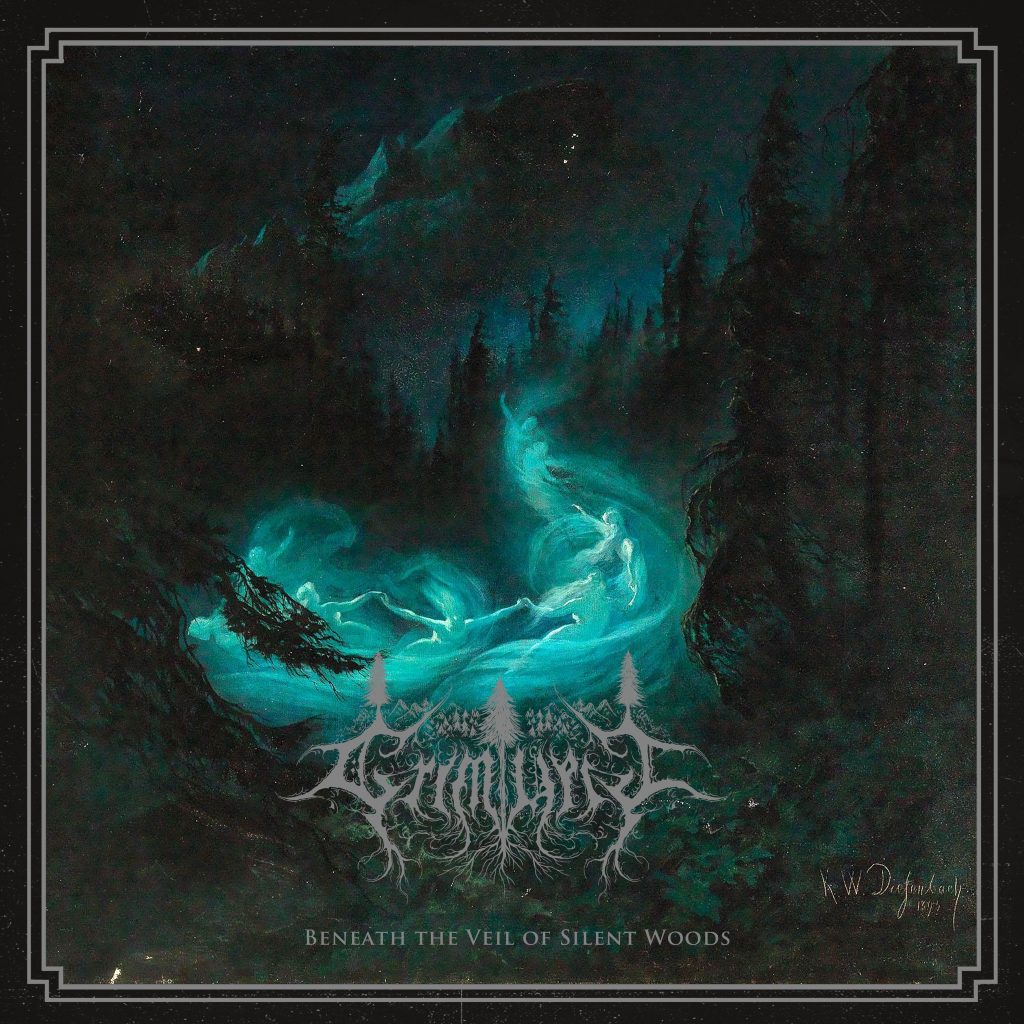
Grimveil – Beneath the Veil of Silent Woods
Record Label: Independent
Year: 2026
Rating: 8/10
Some albums announce themselves with a kick to the chest, and some albums simply materialise around you — gathering at the treeline, pressing in from all sides — until you realise, somewhere around the third track, that you haven’t taken a proper breath in fifteen minutes. Beneath the Veil of Silent Woods, the debut full-length from Swedish German two-piece Grimveil, is the latter kind of record. It does not beg for your attention. It assumes it, and the assumption is entirely warranted.
Grimveil brings together Simon from Tårfödd (northern Sweden) and Revenant from Order of Nosferat (northern Germany) — a collaboration that bridges two rich northern European Black Metal traditions without feeling forced or patchwork. Their joint sensibility sits at the frost-covered intersection of Wolves in the Throne Room’s Pacific Northwest grandeur, the aching folk melancholy of Agalloch, and the isolated keyboard-driven world-building of early Mortiis. Nothing here reinvents the Atmospheric Black Metal wheel, and the duo would probably be the first to tell you that’s not the point. The point is the forest, and whether you can feel it’s cold against your face.
The album opens with Where the Path Fades to Nothing, a genuinely smart refusal: no guitars, no blast beats, nothing to grip. For the first few minutes there is only layered wind, the low murmur of water, and a solitary piano motif that feels fragile enough to dissolve at any moment. When the tremolo riffs finally arrive, they feel less like an introduction and more like an inevitability — as if the forest had simply been waiting for you to stop looking for the path before revealing it. The production, handled by the duo themselves, strikes that elusive balance between raw authenticity and spatial clarity. Crucially, the bass has actual presence here, rumbling with intention beneath the mix rather than disappearing into the low-end fog that claims so many records in this genre.
The album’s first fully realised statement, Into the Depths of Shrouded Pines, moves through grief and gathering fury with the controlled momentum of a storm building on the horizon. Melodic motifs repeat just long enough to root themselves before shifting underfoot, and the blast-beat passage arriving mid-track is all the more effective for its lack of warning. An acoustic passage closes things out, earning every second of its quietude.
Only Trees Bear Witness is a track that earns its slower pace through sheer atmosphere. The central riff cycles with hypnotic intent, though it stops just short of overstaying its welcome. Harsh vocals — a rasping mid-range delivery that serves the music competently without standing as its most distinctive feature — sit well in the mix here, given enough space to breathe without dominating.
The title track is where the record fully declares what it is. Acoustic guitar passages of genuine beauty anchor the piece, with what sounds like a dulcimer threading through the texture like something borrowed from a much older tradition. This is not a Metal song with Folk decoration — it is a Folk composition that occasionally catches fire and burns in a distinctly northern way. That inversion matters. It reframes the entire album as something rooted in landscape rather than genre, and the emotional weight it carries makes it one of the record’s clear standouts.
The Distant Murmur of Trees is a transitional piece that some listeners will find contemplative and others may find slow, depending on how deeply they’ve surrendered to the album’s pacing by this point. The ‘murmur’ of the title is taken seriously: this is a track that whispers more than it shouts, and it works best when treated as a breath between heavier passages rather than a standalone statement.
Where Beauty Breathes in Silence is one of the most structurally interesting pieces on the record. What begins as a sparse, almost chamber-like passage — patient, careful, unhurried — gradually hardens into something more aggressive without ever losing the melodic thread. The dynamic shift arrives with real force precisely because the track has taken its time earning it. Then As Fog Devours the Trail fires in with the most traditionally ‘Black Metal’ track on the album: a cold, furious sprint that calls to mind early Darkthrone in its ice-hardened directness without feeling derivative of it. After the album’s more expansive middle section, this concentrated burst of aggression lands like a closed fist. Brief, purposeful, uncompromising.
Closing piece, The Light that Lives in Leaves is the album’s finest achievement and its most structurally confident move. Over its extended runtime, it slowly dismantles itself — shedding layers of distortion and percussion until nothing remains but the piano motif from the opening track, now harmonised, now transformed. It is a structural decision that rewards the patient listener and creates the almost irresistible urge to begin the record again the moment it ends. The two northern worlds that made this album — Swedish and German, two sensibilities that found genuine common ground — feel most fully unified here.
What makes this collaboration between Simon and Revenant genuinely interesting is that it doesn’t sound like a compromise. The Swedish and German Black Metal traditions share enough common ground — a fondness for atmosphere, for landscape, for the kind of melancholy that thrives in cold climates — that their fusion feels organic rather than assembled. There are moments on this record where the two compositional voices seem to push in slightly different directions, and those moments of productive tension are often the album’s most compelling.
Beneath the Veil of Silent Woods is the work of two artists who understand that texture and patience are not weaknesses, and that a record can be both immersive and emotionally direct without any contradiction between the two. Grimveil have built something genuinely atmospheric here — a debut that functions as landscape, as ritual, and occasionally as a gut-punch, sometimes within a single track.
You Might also Like