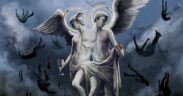
Review: Flykt – Sinister Strain

Share
Review by Rick Eaglestone

Flykt – Sinister Strain
Record Label: Hammerheart Records
Year: 2026
Rating: 7/10
Seven years is a long time to hold your tongue. Since Charnel Heart announced Flykt to the Swedish Black Metal scene in 2019, the Stockholm duo of Andreas (ex-Valkyrja, vocals) and Joel (ex-Rev 16:8, guitars) have said almost nothing: no singles, no updates, no manufactured anticipation. Just absence, and the kind of disciplined silence that suggests something is being built rather than simply delayed. Sinister Strain is the result of that patience, and it arrives not with explanation or apology.
Operating from the Stockholm underground with a studied awareness of both the Orthodox Black Metal tradition and its more dissonant, theurgical offshoots gives Sinister Strain a dual centre of gravity: one foot in the ice-hardened precision of Marduk, the other in the ritual malevolence of Watain’s early years. Crucially, Karl Daniel Lidén’s mix at Tri-Lamb Audio the same studio responsible for records by Craft, Bloodbath, Demonical, and Katatonia, gives this ambition sonic room. The production is dense without being claustrophobic, and the low end has actual mass to it, something this style of Black Metal routinely fails to achieve.

Flykt
Opener You Will Know Them by the Reek of Defeat is a statement of intent in the oldest sense. It enters without ceremony — a mid-paced riff that tightens and accelerates before the blastbeats arrive, driven by Andreas’s caustic bark. What holds the track together is the way Joel’s guitar lines resist predictability. The tremolo-picked phrases curl back on themselves in ways that feel slightly wrong before suddenly, satisfyingly, resolving. It is a track that establishes the album’s fundamental proposition: that Flykt’s Black Metal is built to be felt as well as heard, and that feeling is not warm.
Transcendent Rebellion doubles down on that proposition with blunt effectiveness. This is where the Marduk lineage is most legible: an engine-room blast with riffs that cut and bludgeon in equal measure, but the melodic undercurrent threading through the verse sections gives the track a poisonous shimmer that lifts it above the purely mechanical. Joel’s leads in the final third carry a venomous, spiralling quality that recalls the early Watain of Casus Luciferi: not comfortable, not triumphant, but transfixing.
If those first two tracks establish the album’s attack, An Uncarved Block begins to complicate it. The title’s Taoist reference pu, the unformed state from which all things emerge, is not decorative. The track works through a kind of controlled dissolution: riffs that form and then refuse to settle, rhythmic patterns that shift before they calcify. It is the first moment on the record where Flykt’s stated interest in Abigor and Deathspell Omega becomes more than a name-drop, and it rewards repeated listening more than the tracks that precede it.
The Release and Descent pulls the tempo down and applies pressure from a different angle. Groove-adjacent in its rhythm, unhurried in its sense of threat, it is the album’s most structurally patient track and its most polarising. Some listeners will find its mid-paced momentum irresistible; others will want it to break open sooner than it does. The track does eventually reach a point of genuine ugliness in its final section, the riff caving inward under its own weight, but it asks for commitment before offering that payoff.
Armed With Countless Daimons Seeking Abode is where Sinister Strain most fully declares what kind of album it is. The title’s baroque length signals intent: this is a track that operates with ritual seriousness, building through dissonant guitar work and controlled acceleration toward an ambient closing passage of real menace. The way the distortion withdraws and lets the atmosphere breathe not in release, but in threat is the record’s most compositionally ambitious moment. It is a track that earns its runtime because every section is doing something specific, moving toward something, not simply sustaining.
Rebirth in the Name of Reprisal and Unswerving Strife, Unyielding Will form a mid-album pairing that drives hard and trades the preceding track’s complexity for directness. The former is compact and ferocious, a reminder that Flykt can simply play fast and mean it; the latter extends that aggression slightly, allowing a melodic fragment to surface before the track consumes it. Neither reaches the heights of what surrounds them, but both serve the album’s pacing with workmanlike purpose.
Closing stretch A Furnace for the Stars and There Comes the Light represent the album’s closing sequence, and they are doing very different things. The former is brief, less than three minutes functioning as a scorched, instrumental bridge rather than a destination in itself: a riff that burns with concentrated intensity before extinguishing as abruptly as it ignited. It is less a track than a threshold. There Comes the Light is where the album’s real weight finally settles. At over fourteen minutes, it is the record’s structural centrepiece by length and by ambition, moving from controlled aggression into something more expansive and more deliberately unresolved, atmospheric passages that gather without quite breaking, dynamics that expand and recede without offering release. It is the track that will lodge in the memory longest, the moment where Flykt’s synthesis of orthodoxy and dissonant ritual sounds most fully integrated. The light of the title does not comfort. It does not arrive. It threatens to.
Sinister Strain is not a perfect record. The mid-section occasionally allows momentum to plateau rather than build, and the band’s most distinctive voice — that dissonant, occult sensibility heard most clearly on An Uncarved Block and Armed With Countless Daimons Seeking Abode could profitably colonise more of the running time on a third album. Flykt are at their most compelling when they resist the pull of orthodoxy rather than simply coexisting with it.
But those are observations about potential rather than failures of execution. What Flykt have made here is a second album that justifies its long gestation: tighter than Charnel Heart, more varied in its construction, more assured in the moments where it takes creative risks and produced with a clarity that allows its most extreme passages to hit without congestion. Andreas and Joel have spent seven years building toward something, and Sinister Strain demonstrates that the wait was not idleness. It was precision.
You Might also Like